
Executive Summary
How Fourlane helped a multi-location restoration services organization rescue a stalled ERP migration and build a scalable financial foundation.
Migrating from QuickBooks Online (QBO) to Intuit Enterprise Suite (IES) is more than a software implementation project – it is a financial transformation initiative.
When this multi-market regional disaster restoration operator attempted to consolidate multiple QuickBooks Online Advanced environments into Intuit Enterprise Suite, they partnered with a technical IES reseller. However, they encountered major accounting and operational challenges during the migration.
The company needed more than technical migration assistance. They needed a partner that understood both ERP systems and accounting operations.
Fourlane stepped in to diagnose the failed migration, rebuild the accounting structure, reconcile historical data, and create a scalable ERP environment capable of supporting future growth. The result was a successful Intuit Enterprise Suite migration.
The Challenge: A Stalled Intuit Enterprise Suite Migration
Following an asset acquisition, the company began restructuring operations under a unified organizational model. Historically, the business operated through multiple QuickBooks Online Advanced environments, each with separate accounting structures, reporting methods, and operational workflows.
Leadership initiated a migration to Intuit Enterprise Suite to:
- Consolidate multiple QBO instances
- Improve reporting visibility
- Support intercompany accounting
- Enable location-based operational reporting
- Create scalable financial processes
- Improve month-end close efficiency
However, by the time Fourlane was brought into the project, the migration had stalled.
Key Migration Problems Identified
Incomplete Accounts Receivable and Accounts Payable Migration
Only partial AR and AP detail had been migrated into IES. Open balances existed without transaction-level support, making:
- Customer aging unreliable
- Vendor balances difficult to validate
- Collections workflows ineffective
- Cash forecasting inaccurate
Summary-Level Journal Entries Replaced Operational Detail
Historical activity had been imported using summarized journal entries instead of preserving invoice-level and payment-level transactions. This created reconciliation problems between:
- QuickBooks Online
- Intuit Enterprise Suite
- Bank activity
- Financial statements
- Customer balances
- Vendor ledgers
Duplicate Revenue Recognition
Detailed invoices loaded into IES automatically recognized millions in revenue that had already been reflected through manual journal entries. The result:
- Revenue duplication
- Artificial balancing entries
- Misstated financial activity
- Increased audit risk
Intercompany Accounting Confusion
Sweep accounts and intercompany accounts were configured inconsistently. Several accounts simultaneously functioned as:
- Bank accounts
- Clearing accounts
- Intercompany accounts
- Suspense accounts
This created significant consolidation and elimination issues.
Balance Sheet Integrity Issues
Although the Profit & Loss statements appeared directionally accurate, the underlying balance sheet structure contained serious integrity problems. The Fourlane team uncovered:
- Unreconciled AR balances
- Duplicate transactions
- Missing customer detail
- Incorrect invoice dating
- Misapplied payments
- Opening balance discrepancies
- Uncleared vendor balances
- Timing variances
- Interest accrual inconsistencies
Most importantly, the accounting records no longer accurately reflected the actual operational events of the business.
Why the Existing ERP Migration Was Failing
The prior implementation focused primarily on technical migration steps. But migrating from QuickBooks Online to Intuit Enterprise Suite requires more than moving data from one system into another. The existing migration used shortcuts that made the financials appear balanced while masking underlying structural issues. The balance sheet technically tied. But the accounting story behind the numbers no longer made sense.
That distinction became critical.
Fourlane’s Approach to the Intuit Enterprise Suite Migration Recovery
Fourlane approached the engagement as both an ERP migration recovery project and an accounting reconstruction initiative.
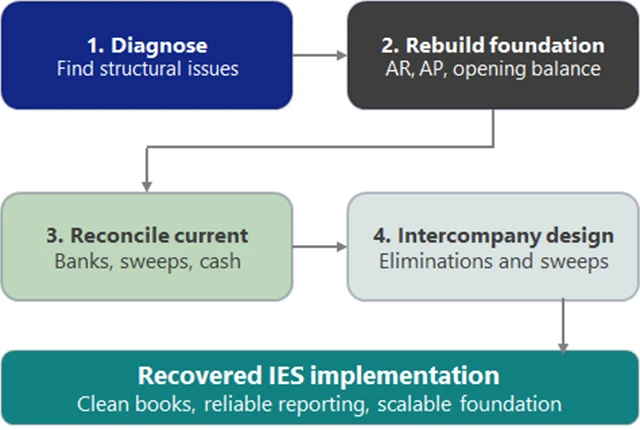
Step 1: Diagnose the Real Accounting and ERP Problems
Before making any corrections, Fourlane performed a comprehensive analysis of:
- Legacy QuickBooks Online files
- Existing IES environments
- Chart of accounts structures
- Dimensions and location tracking
- Consolidation logic
- Historical transaction activity
- Beginning balance entries
- AR and AP workflows
- Bank reconciliations
- Intercompany accounting processes
The analysis revealed that many issues were not isolated mistakes. They were structural migration decisions that prevented the ERP system from accurately representing the business.
Examples Included
- Historical invoices imported with incorrect dates
- AR balances migrated without customer-level detail
- Revenue recognized through summary-level entries
- Plug entries used to force balances to tie
- Sweep accounts masking intercompany activity
- Missing elimination strategies for consolidated reporting
Rather than layering additional fixes on top of bad data, Fourlane recommended rebuilding critical portions of the migration correctly.
Step 2: Rebuild the Accounting Foundation
Accounts Receivable Cleanup and Reconciliation
Fourlane performed detailed invoice-level AR tie-outs between QBO and IES. The process included:
- Invoice comparisons
- Payment application reviews
- Customer mapping validation
- Aging analysis
- Interest accrual analysis
- Open balance testing
- Line-item variance reviews
Where possible, discrepancies were corrected directly. Where transactional repair was no longer practical, Fourlane implemented strategic true-up entries that preserved financial accuracy without overengineering the solution. This balanced accounting integrity with implementation efficiency.
Accounts Payable Reconciliation
The team reviewed AP structures for:
- Duplicate vendors
- Timing variances
- Invoice numbering inconsistencies
- Misapplied bills
- Uncleared liabilities
Vendor balances were corrected and aligned to ensure accurate liabilities moving forward.
Opening Balance Sheet Validation
One of the most important aspects of the project was validating the opening balance sheet after the asset acquisition. Fourlane worked closely with leadership to:
- Validate the acquisition-date balance sheet
- Separate acquisition accounting from operational activity
- Preserve historical continuity
- Ensure post-acquisition transactions were properly reflected
- Build accurate consolidated reporting structures
This distinction became foundational to the long-term success of the ERP implementation.
Step 3: Reconcile Through Current Activity
Rather than stopping reconciliation at the historical cutoff date, Fourlane extended reconciliation work through current operational activity for one entity. The team tied out:
- Bank accounts
- Bill.com clearing accounts
- Sweep accounts
- Credit card accounts
- Intercompany balances
- Cash activity
This prevented the organization from inheriting stale financial data at go-live. It also accelerated the organization’s ability to close future periods accurately.
Step 4: Design Sustainable Intercompany Accounting Processes
One of the most complex aspects of the engagement involved architecting a sustainable intercompany accounting framework. Fourlane worked with leadership to distinguish:
- Transactions that should eliminate during consolidation
- Operational transfers between locations
- True intercompany activity
- Clearing account workflows
- Cash sweep structures
The team designed separate strategies for:
- Legacy entity cleanup
- Future-state operational accounting
- Consolidated reporting workflows
This created a much cleaner long-term accounting structure inside Intuit Enterprise Suite.
The Results
By the end of the engagement, the company achieved a successful ERP recovery and accounting stabilization initiative.
- Clean Financial Records: The organization gained a clean and accurate accounting foundation from acquisition forward.
- Reconciled Accounts Receivable and Accounts Payable: Critical customer and vendor balances were validated, corrected, and tied out.
- Improved Balance Sheet Integrity: Leadership gained confidence in the accuracy and reliability of the underlying financials.
- Better Consolidation Workflows: Intercompany transactions, sweep accounts, and entity consolidation processes became significantly more manageable.
- A Scalable ERP Environment: Intuit Enterprise Suite became a platform capable of supporting growth rather than simply storing accounting data.
Need Help Migrating to Intuit Enterprise Suite?
ERP implementations succeed when accounting and technology work together.
At Fourlane, the goal is never simply to move transactions from one system into another. The goal is to preserve the financial story behind the business while creating scalable systems that support future growth.
If your organization is struggling, Fourlane can help.
Contact Fourlane to learn how our team combines accounting expertise and ERP implementation strategy to deliver successful Intuit Enterprise Suite migrations.