

Outgrowing QuickBooks Online? When to Move to Intuit Enterprise Suite (Intuit ERP)
What happens when your company’s revenue climbs, subsidiaries multiply and the month-end close stretches from days to weeks? QuickBooks Online Advanced has fueled your growth so far, yet the thought of leaping into a heavyweight ERP – with six-month implementations, sprawling feature sets and steep fees – feels like swapping one pain for another. If you’re caught between a platform that suddenly seems too small and a category of software that looks far too big, you’re not alone.
This blog outlines a middle path: Intuit Enterprise Suite (Intuit ERP). We’ll compare its familiar QuickBooks-style experience with traditional ERP systems and walk through a real-world migration from QuickBooks Online Advanced to IES. Intuit describes IES as “a configurable AI-powered business platform that brings together all of your financial, payroll, HR, marketing and cash flow tools in one place” while pairing each customer with dedicated success managers for a smoother journey configurable AI-powered business platform. By the end, you’ll know where IES fits, what makes it different and how to decide whether it’s the right next step for your organization.
Recognizing When QuickBooks Online Advanced Is No Longer Enough
Rapid expansion is great for the top line, but it can expose every weak link in your accounting stack. When finance teams start chasing data instead of insights, the culprit is often a system that has reached its practical limits. In QuickBooks Online Advanced, those limits typically show up in frustrations that pull controllers and CFOs away from higher-value work.
Here are the four warning signs we see most often:
- A growing web of connected apps makes routine tasks feel like a scavenger hunt with every integration introducing its own set of sync schedules and support tickets
- Manual reconciliations absorb evenings and weekends as you match transactions that never quite line up across platforms
- Reports reach executives long after decisions have been made, turning financial statements into history lessons instead of steering tools
- Visibility breaks down across entities, leaving you to stitch together spreadsheets just to answer basic questions about consolidated cash or project profitability
Understanding Why Patchwork Systems Create More Risk
Each new point solution bolted onto core accounting raises the odds of data silos, duplicate entries or version-control headaches. Over time, these disconnects slow month-end closes, erode confidence in numbers and force finance teams to maintain fragile Excel workbooks. When the back office spends more time compiling data than interpreting it, growth decisions become guesswork. To move faster and sleep easier, companies eventually need a platform built for coordinated multi-entity operations.
Comparing Intuit Enterprise Suite with Traditional ERPs
For growing firms that have eclipsed QuickBooks Online Advanced yet dread diving into a heavyweight ERP, Intuit Enterprise Suite offers a different equation. Traditional ERPs, such as NetSuite and Sage promise expansive functionality, but many mid-market executives find projects dragging on for months before users see value. IES instead aims to deliver enterprise-grade controls without overwhelming teams that grew up on QuickBooks.
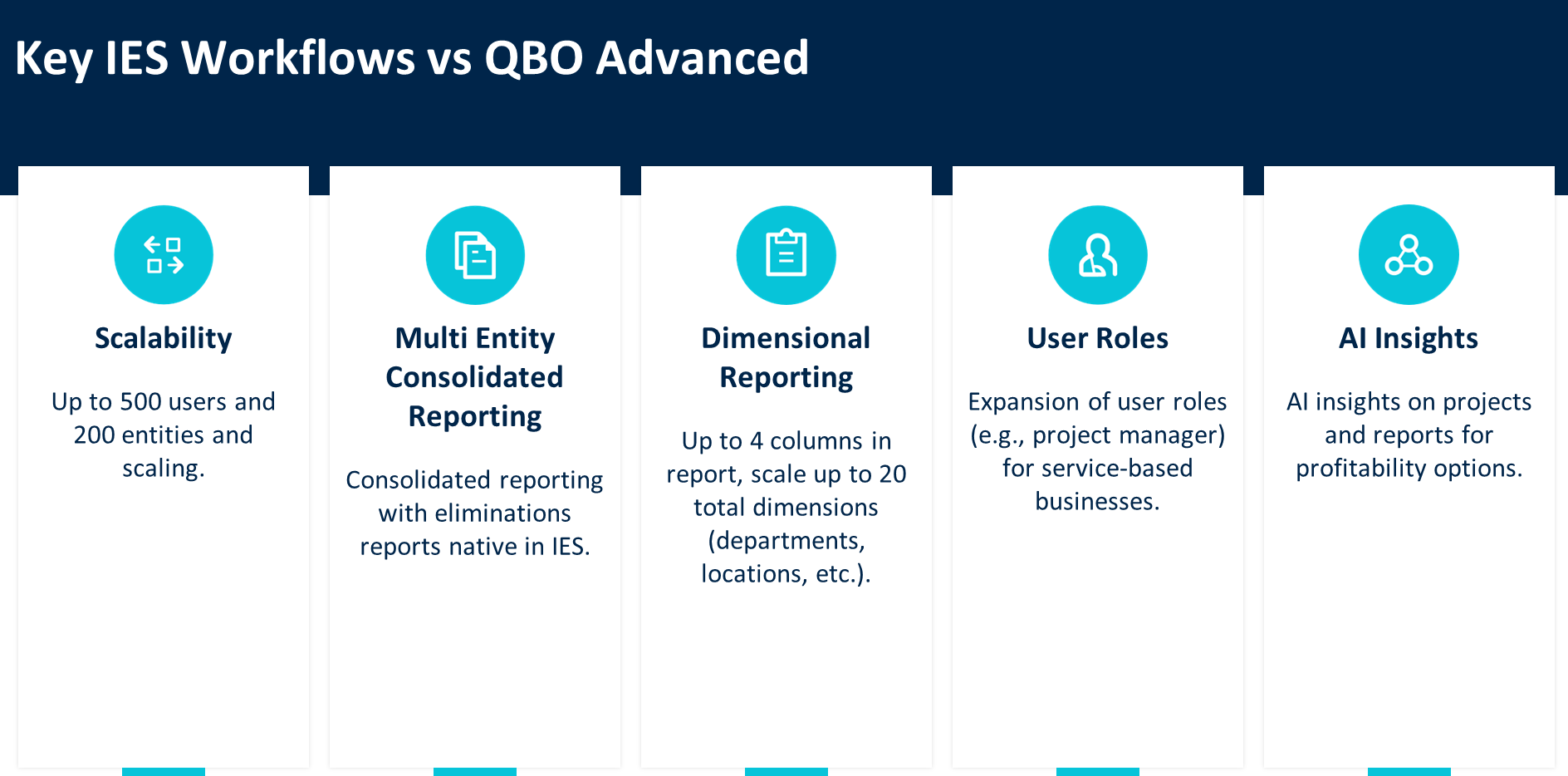
Intuit’s launch team notes that companies often feel the pinch once revenue approaches two to five million dollars, while IES can still support businesses well past the hundred-million-dollar mark. The goal is right-sizing: enough power for multi-entity controls, not so much scope that staff drown in unused functionality.
Evaluating Ease of Adoption and Time to Value
According to Intuit, “your data is automatically migrated to Intuit Enterprise Suite and no additional work is needed” when upgrading from QuickBooks Online. The same comparison page also lists average implementation timelines of less than two months, a fraction of typical ERP rollouts.
Evaluating Cost, Scope and Long-Term Fit
Paying for modules you never use is a common ERP gripe. IES counters by bundling multi-entity accounting, revenue recognition, AI-driven FP&A and dimensional reporting into one subscription. Customers see the appeal. As Matt Van Der Molen, CMO of Four Points RV Resorts, explains, “We’ve now been moved over to the Intuit Enterprise Suite. It has immediately solved the issues we’ve had as it relates to multi-entity.” The takeaway: IES can satisfy advanced finance requirements without the administrative bulk or price tag of a larger ERP.
With positioning and cost questions addressed, let’s explore the capabilities that set IES apart.
Exploring Features That Make IES Stand Out
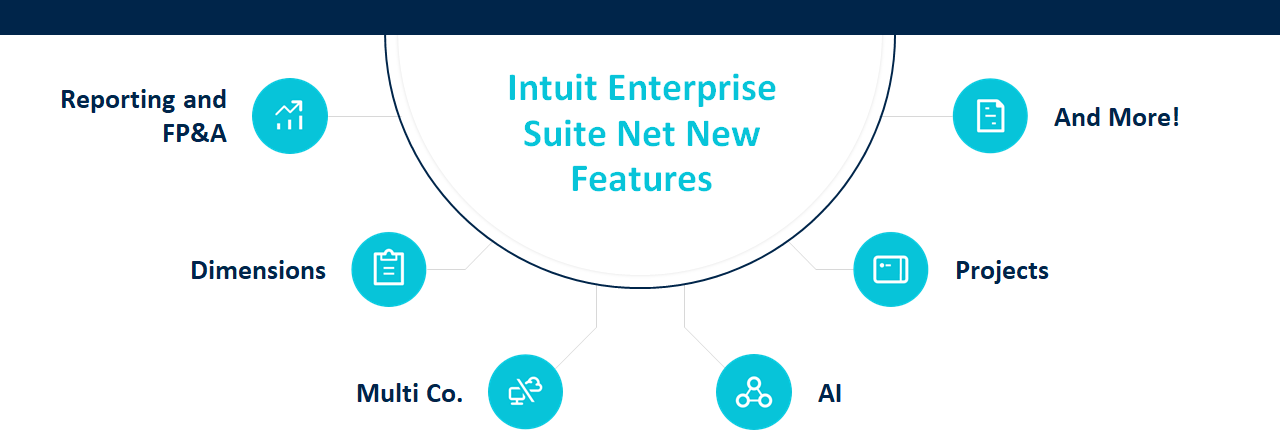
IES bundles the capabilities finance leaders usually piece together from multiple tools into one cloud accounting suite. Intuit highlights built-in multi-entity accounting, revenue recognition, AI-powered FP&A, dimensional reporting and automated fixed-asset tracking, trimming the need for extra licenses and connectors.
Managing Multiple Entities with Less Manual Work
IES lets controllers create intercompany journal entries with automatic eliminations, giving them consolidated views without hours of spreadsheet gymnastics. Finance teams can work from a single login across all subsidiaries, generate side-by-side dashboards for any entity and slash the manual effort that drags out month-end routines. Laura Davidson, Partner at Fourlane, notes that when eliminations run behind the scenes, “the close stops feeling like triage and analysts can finally focus on performance, not data wrangling.”
Turning Data into More Actionable Reporting
Instead of exploding the chart of accounts, IES extends QuickBooks classes with up to 20 customizable dimensions. That flexibility lets you analyze profitability by project, department or service line and still keep the ledger lean. AI agents watch for anomalies and variance patterns, flagging unusual swings before they distort forecasts so finance leaders can respond in real time.
Automating Cash Flow and Finance Workflows
Automation threads through every core workflow. Intuit reports that companies using IES send pay-enabled invoices and AI-generated reminders that help them “get paid up to 45% faster,” while pre-filled vendor bills shave minutes off every AP entry. Integrated Mailchimp campaigns often see email click-through rates about 1.6 times higher than non-integrated sends, proving that connected data can boost marketing outcomes too.
These capabilities show why many QuickBooks users view IES as a right-sized step rather than a leap into ERP bureaucracy. Next, let’s bring the advantages to life with a migration story.
Following a Real Migration from QuickBooks Online Advanced to IES
Defining the Problems the Team Could No Longer Ignore
A fast-growing group of seven related companies – covering equipment leasing, aviation support and investment holdings – relied on separate QuickBooks Online Advanced files. Overlapping charts of accounts, duplicate vendors and tangled intercompany entries turned every close into a marathon. Leadership lacked timely visibility and risk ballooned as operational data from a new Microsoft Dynamics Field Service rollout loomed.
Designing the Migration Around the Future State
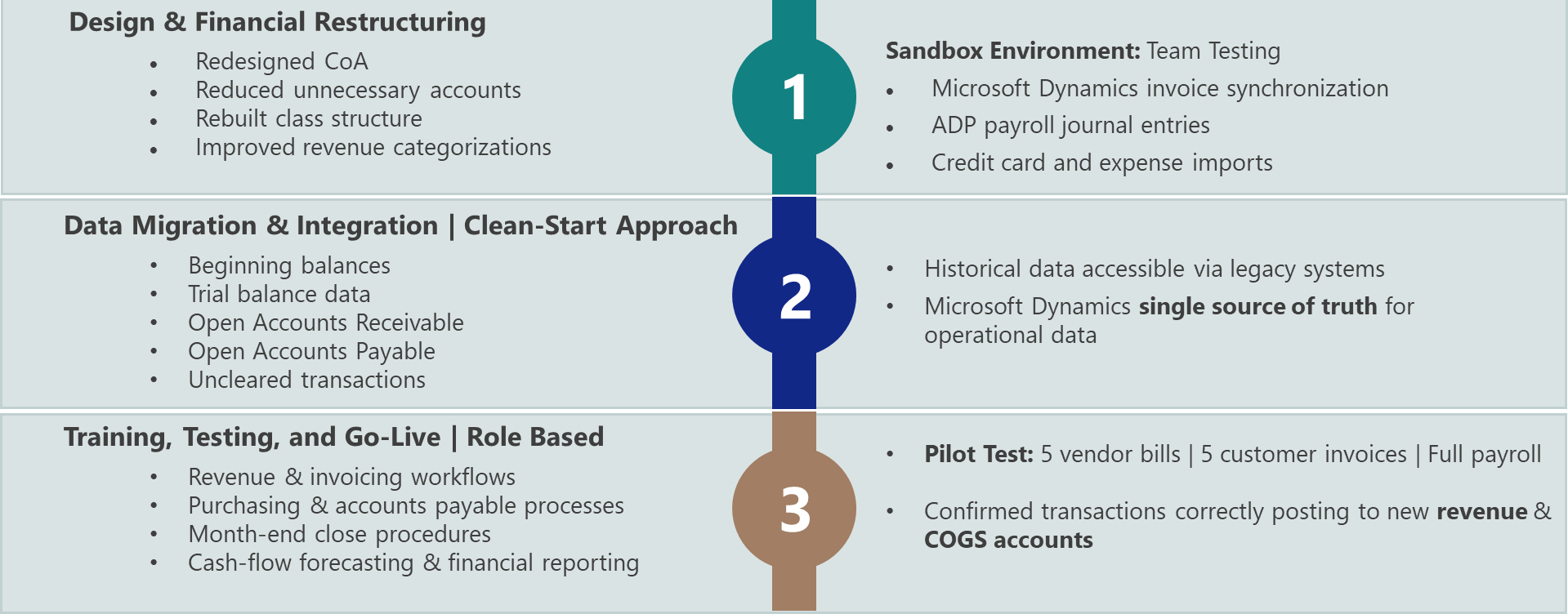
During discovery, Fourlane weighed two options: consolidate everything into one supersized QuickBooks Online file or switch to IES with a true multi-entity structure. Scale and compliance requirements made IES the obvious choice. The team rebuilt the chart of accounts around shared dimensions, aligned classifications across entities and tested integrations in a sandbox before moving live data. They opted for a clean start, migrating only beginning balances, open AR, open AP and unresolved transactions while retaining legacy files for historical reference.
Measuring What Improved After Go-Live
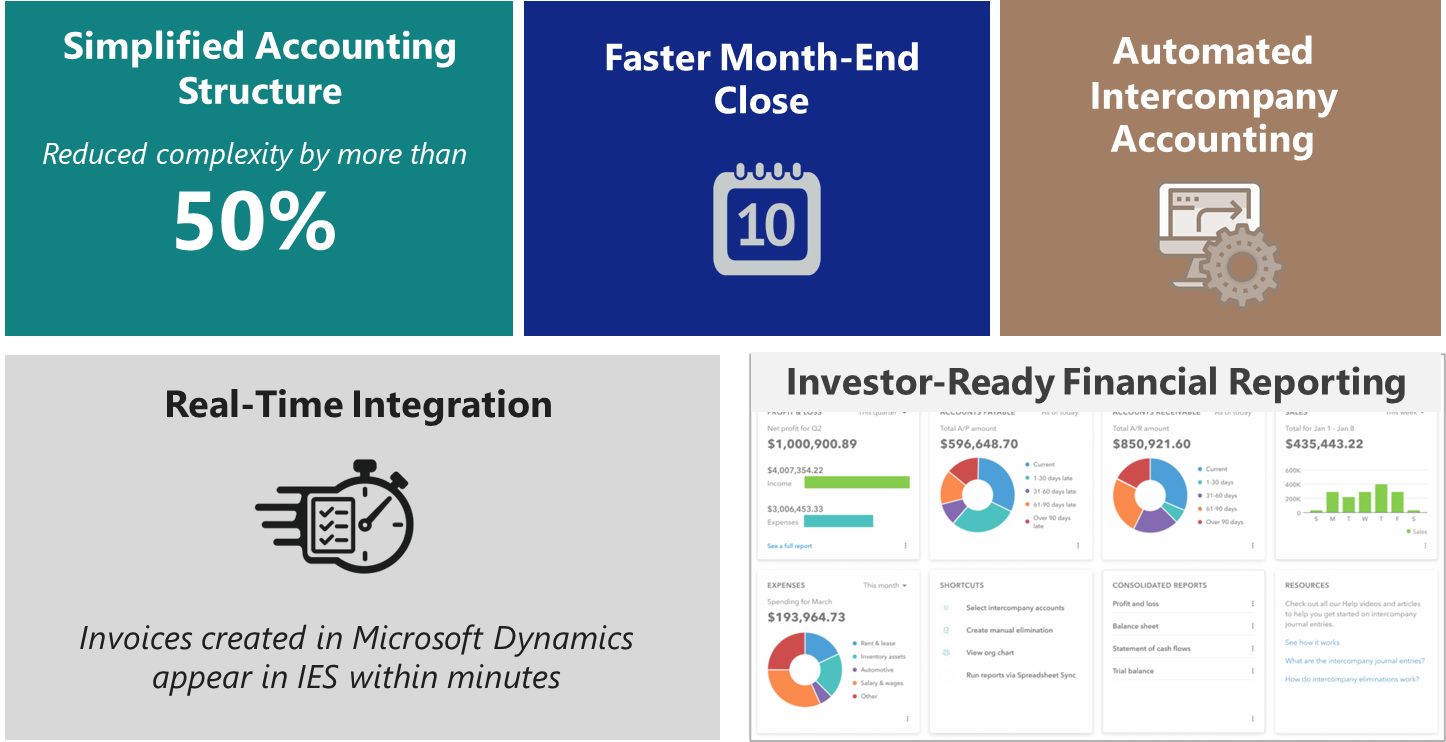
With IES live, Dynamics pushed operational data directly into the suite, turning IES (Intuit ERP) into the financial system of record. Accounting complexity fell by more than 50 percent, intercompany eliminations ran automatically and the month-end close dropped from several weeks to about 10 business days. Centralizing the books let the CFO monitor profitability across entities in near real time and freed analysts to drive forecasting, not firefighting.
Deciding Whether IES Is the Right Next Step
Companies that outgrow QuickBooks Online Advanced often share a few traits: multiple legal entities, heavier compliance requirements and leadership that can’t wait weeks for clean numbers. Ask yourself:
- How many entities or locations do you manage today and will that count rise soon?
- Do you spend more time preparing consolidated reports than interpreting them?
- Are critical workflows such as payroll, AP or project billing already spread across several apps?
- Can your team commit the resources required for a focused 60-day implementation and role-based training?
Knowing When to Seek Expert Guidance
Migration touches internal controls, tax compliance, dimension design, user permissions and training. Here at Fourlane, an award-winning QuickBooks Solution Provider since 2010, our consultants use a structured DRIVE™ framework to align data models, workflows and compliance requirements before the first record moves. A seasoned advisor helps you avoid stretching QuickBooks too far or overbuying on ERP features, guiding you through sandbox testing and role-based training so the final solution matches today’s workloads and tomorrow’s growth plans.
Moving Up with More Confidence
Intuit continues to add new features to IES each quarter, ensuring the platform evolves alongside your business. When you’re ready to evaluate next steps, remember that you don’t have to navigate the process alone. As the #1 Intuit QuickBooks Solution Provider for more than a decade, Fourlane has guided thousands of organizations through migrations, data conversions and custom training programs. Our team can help you assess whether Intuit Enterprise Suite – or another ERP – aligns with your goals, design a migration path that respects compliance requirements and deliver training that accelerates adoption.
Ready to see how a right-sized enterprise platform can streamline financial management, sharpen reporting and free your team for higher-value work? Contact Fourlane today for a personalized consultation.
