

Intuit Enterprise Suite (IES) is a cloud-based financial management platform built for mid-sized and large nonprofits that have outgrown QuickBooks Online but don’t need a full ERP. It supports fund accounting, grant tracking, multi-entity consolidation, and AI-assisted reporting – making it a strong Sage Intacct alternative for organizations in the $3M–$50M revenue range.
If your nonprofit is wrestling with restricted funds tracked in spreadsheets, manual grant reporting, or month-end consolidation that takes weeks instead of days, Intuit Enterprise Suite for nonprofits is worth understanding. This guide walks through what IES does, where it fits well, where it doesn’t, and how to evaluate it against alternatives like Sage Intacct, Blackbaud Financial Edge NXT, and NetSuite.
What Is Intuit Enterprise Suite?
For nonprofits specifically, IES functions as comprehensive nonprofit accounting software – supporting fund accounting, restricted-fund tracking, grant management, and consolidated reporting across affiliated entities. It sits between QuickBooks Online (which fits smaller nonprofits) and full ERP systems like NetSuite (which often overshoot mid-sized nonprofit needs).
Who Built It and Why It Matters
IES was developed by Intuit – the same company behind QuickBooks, used by an estimated 80% of small businesses in the U.S. for accounting. That matters for nonprofit finance leaders for two reasons:
- Familiar interface. Staff and volunteers already trained on QuickBooks Online face a shorter learning curve.
- Migration path. Nonprofits moving from QuickBooks Online to IES benefit from automatic data migration within the Intuit ecosystem.
Why Nonprofits Are Moving to IES
Nonprofit finance is structurally different from for-profit accounting, and those differences compound as an organization grows. A small nonprofit with one funding stream can run on basic accounting software. A nonprofit running fifteen grants, four programs, and two affiliated entities cannot – at least not without spreadsheet workarounds that consume the finance team’s capacity.
The signs that a nonprofit has outgrown its current accounting software are consistent across the sector:
- Spreadsheet sprawl – the general ledger lives in QuickBooks, but the real reporting happens in parallel Excel files for grant burn-down, restricted fund balances, and board packets
- Manual allocations – every shared expense (rent, salaries, technology) requires a journal entry to spread across programs and grants
- Audit anxiety – when auditors request a grant-by-grant expenditure report tied to the financial statements, the finance team spends days reconciling rather than producing it on demand
- Board reporting lag – packets arrive two to three weeks after period close because data has to be exported, reformatted, and reconciled
These are toolset problems, not staff problems. And they are exactly what Intuit Enterprise Suite is designed to address.
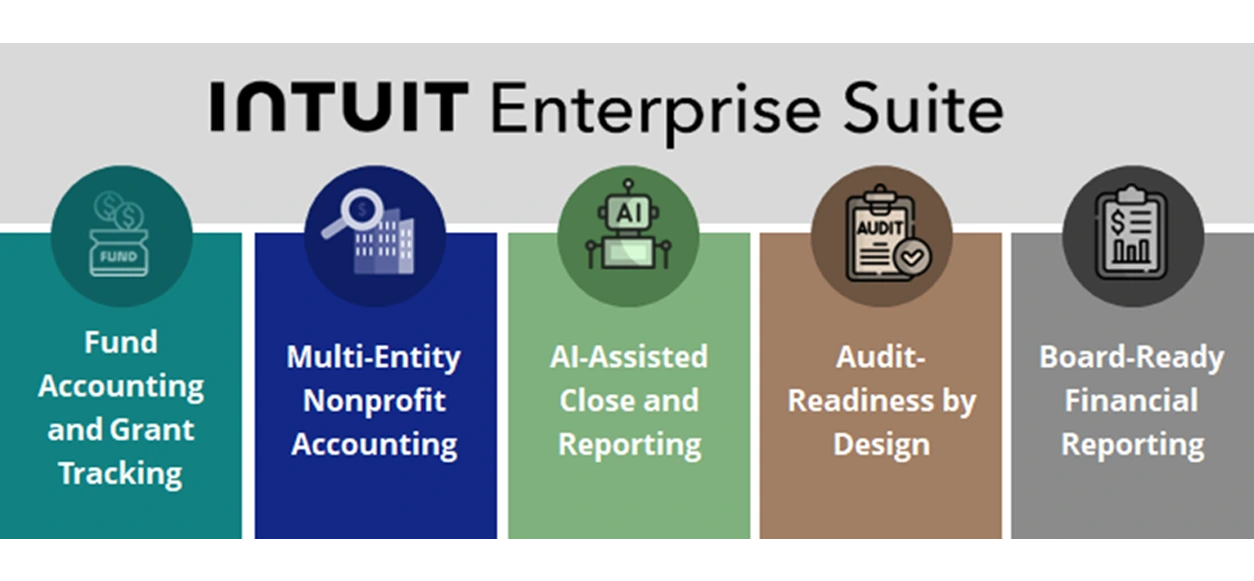
Key Features for Nonprofit Finance Teams
-
Fund Accounting and Grant Tracking
The most important architectural shift in IES for nonprofits is its dimensions framework. Rather than overloading classes, locations, or sub-accounts to track restrictions, IES allows transactions to be tagged with multiple dimensions at the line-item level – grant, fund type, restriction status, program, location, funder, and more.
In practice, a single $50,000 expense can be cleanly allocated across two grants and three programs without manual journal entries, then reported on from any of those angles in real time. Budget-versus-actual at the grant level becomes a live view rather than a quarterly spreadsheet exercise.
For nonprofits operating under fund accounting principles and GAAP requirements for restricted contributions, this is typically the feature that justifies the move from QuickBooks Online.
-
Multi-Entity Nonprofit Accounting
Nonprofits with chapters, affiliated entities, fiscal sponsorships, or holding structures have historically had two options: maintain separate QuickBooks files and consolidate manually each month, or move to a full ERP system.
IES supports up to 100 entities under a single login, with:
- Automated intercompany transaction handling and eliminations
- Standardized chart of accounts across subsidiaries
- Consolidated financial statements generated in real time
- Drill-down from consolidated view to a single entity’s general ledger
For a five-chapter nonprofit federation, this collapses what was previously a multi-day consolidation exercise into an on-demand view – exactly what auditors and board treasurers expect.
-
AI-Assisted Close and Reporting
Recent IES releases have added AI capabilities aimed at reducing the operational drag of monthly close:
- Accounting Agent – scans incoming bank-feed transactions, matches vendors and categories, and groups matches for review
- Finance Agent – generates monthly performance summaries across entities and surfaces drivers of variance
These tools don’t replace finance judgment. They reduce the volume of mechanical work that fills a nonprofit accountant’s week, freeing capacity for the analysis program leaders and boards actually need.
-
Audit-Readiness by Design
Audit preparation is one of the clearest pressure tests of a nonprofit’s financial systems. IES supports audit-ready accounting through several connected capabilities:
- Granular role-based permissions that demonstrate segregation of duties
- Configurable approval workflows for AP, journal entries, and intercompany transactions
- Native restricted-fund tracking that ties directly to the financial statements
- Consolidated reports pulled directly from the ledger, avoiding version-control issues from exports
Finance teams currently spending two to three weeks per audit cycle on schedule preparation typically see meaningful reductions once fund tracking moves from spreadsheets into the GL.
-
Board-Ready Financial Reporting
Boards increasingly expect financial information that is both timely and decision-grade – program-level profitability, grant utilization rates, runway analysis, and KPI dashboards.
IES includes customizable, industry-specific dashboards and KPIs for nonprofits, plus consolidated reporting that pulls cross-entity data without exports to spreadsheets or third-party BI tools. For finance leaders who have been hand-building board packets in Excel and PowerPoint, this is often the most visible day-to-day improvement.
Who IES Is Right For (and Who It Isn’t)
Intuit Enterprise Suite for nonprofits is not a universal answer. Honest assessment matters.
IES Is Likely a Strong Fit If Your Nonprofit:
- Operates in the $3M–$50M annual revenue range
- Manages five or more active grants or restricted funding sources
- Runs multiple programs, chapters, affiliated entities, or fiscal sponsorships
- Has outgrown QuickBooks Online Advanced but isn’t ready for a full ERP
- Spends meaningful staff time on manual consolidation, allocation, or audit preparation
- Has a finance leader who can champion the implementation
IES Is Probably Not the Right Fit If:
- Your nonprofit is under $1M in revenue with a single funding stream and one program (stick with QuickBooks Online Plus or Advanced)
- You have highly specialized industry needs that require a deeply vertical solution (some healthcare or research nonprofits)
- You lack the internal finance capacity to lead an implementation
- You already have a stable Sage Intacct, NetSuite, or Blackbaud Financial Edge NXT implementation that meets current needs
How IES Compares to Other Nonprofit Accounting Software
Most nonprofits evaluating IES are also looking at one or more of the following platforms.
How Does IES Compare to Sage Intacct?
Sage Intacct is widely regarded as the gold standard for nonprofit fund accounting and has historically been the default choice for nonprofits in the $5M+ range. It offers deeply nonprofit-specific reporting, including budget-vs-actual per grant and reimbursable grant tracking.
IES is closing the gap with its dimensions framework and consolidated reporting, while typically offering lower total cost of ownership and a faster implementation timeline. IES tends to be the stronger choice for nonprofits already on QuickBooks who want to scale up without a full platform migration. Sage Intacct remains the stronger choice for nonprofits with highly complex grant-compliance reporting needs or those that prioritize the deepest nonprofit-specific functionality available.
How Does IES Compare to QuickBooks Online?
QuickBooks Online (Plus and Advanced) works well for nonprofits under $3M in revenue with simple fund structures. It supports basic class-based fund tracking, donor management, and grant tagging.
IES becomes the better option once an organization needs multi-entity consolidation, more than five active grants, or line-item dimensional reporting. The migration path within Intuit is direct, and staff trained on QuickBooks Online face a short learning curve.
How Does IES Compare to NetSuite?
NetSuite is a full ERP system that scales to very large nonprofits with complex operations across CRM, HR, supply chain, and finance.
IES is purpose-built for the middle of the market – organizations that need enterprise-grade financial capabilities but don’t need (or want to pay for) a full ERP implementation. For most nonprofits in the $3M–$50M range, NetSuite is overkill and IES delivers the financial functionality at a fraction of the implementation cost and timeline.
How Does IES Compare to Blackbaud Financial Edge NXT?
Blackbaud Financial Edge NXT is purpose-built for nonprofits and integrates tightly with Blackbaud’s fundraising and CRM products. It’s the natural fit for nonprofits already in the Blackbaud ecosystem.
IES is the natural fit for nonprofits already in the Intuit ecosystem or those wanting tighter integration with Mailchimp, QuickBooks Payments, and the broader Intuit stack.
How to Evaluate IES for Your Nonprofit
Finance leaders evaluating Intuit Enterprise Suite should expect a more consultative process than a typical SaaS purchase. The platform is configurable, and good implementations are paired with a partner who understands nonprofit accounting – fund accounting principles, grant compliance, audit requirements, and the reporting cadences your funders and board expect.
A reasonable evaluation includes:
- Discovery conversation focused on current systems, pain points, and growth trajectory
- Tailored demonstration showing IES configured for your fund structure and reporting needs
- Reference conversation with a comparable nonprofit already using the platform
- Implementation plan with timeline, data migration approach, and training scope
- Transparent pricing inclusive of licenses, implementation, and any third-party integrations
If a vendor is unwilling to do any of the above, that’s useful information.
Frequently Asked Questions
How much does Intuit Enterprise Suite cost for nonprofits?
IES uses contract-based pricing customized to organization size, number of users, and required dimensions. VARs (Fourlane) can offer Preferred Client Pricing off MSRP. Most nonprofits should expect IES to cost more than QuickBooks Online Advanced but typically less than Sage Intacct or NetSuite.
Does Intuit Enterprise Suite support fund accounting?
Yes. IES supports nonprofit fund accounting through its dimensions framework, allowing organizations to track restricted and unrestricted funds, donations, grants, and program expenses in real time while maintaining GAAP compliance.
Can IES handle multiple grants?
Yes. IES is well-suited for nonprofits managing five or more active grants. The dimensions framework allows transactions to be tagged with grant, funder, restriction status, and program at the line-item level, enabling real-time budget-versus-actual tracking per grant.
Is IES a good QuickBooks alternative for larger nonprofits?
Yes. IES is purpose-built for organizations that have outgrown QuickBooks Online Advanced but aren’t ready for a full ERP. It maintains a familiar QuickBooks-style interface while adding multi-entity consolidation, dimensional reporting, AI-assisted automation, and granular access controls.
How long does IES implementation take for a nonprofit?
Implementation timelines typically run two to four months for nonprofits, depending on the complexity of the fund structure, number of entities, and historical data being migrated. This is significantly faster than a typical Sage Intacct or NetSuite implementation, which often runs six to twelve months.
Does IES integrate with donor management systems?
Yes. IES integrates with common nonprofit tools including donor management systems, fundraising platforms, and CRMs through Intuit’s app marketplace and third-party integration partners. This allows donor and grant data to flow directly into accounting and reporting without manual entry.
The Bottom Line: Is IES Right for Your Nonprofit?
Intuit Enterprise Suite for nonprofits offers something that has been hard to find in the nonprofit financial software market – enterprise-grade capability with a lower total cost of ownership than full ERP systems, an implementation timeline measured in months rather than years, and a configuration tailored to fund accounting rather than retrofitted from a for-profit foundation.
The nonprofits most likely to benefit are those caught between two unsatisfying options: a tool they have outgrown, and an ERP that overshoots their actual needs. For organizations in that gap – typically $3M to $50M in revenue, managing multiple grants and entities – IES is worth a serious evaluation.
Whether it is the right answer for your organization depends on the specifics. But it is worth understanding before defaulting to either the tool you have outgrown or the ERP you have been told you need.
Is Your Nonprofit Outgrowing QuickBooks?
If your finance team is struggling with manual grant tracking, spreadsheet-based consolidations, delayed board reporting, or restricted fund management, it may be time to evaluate a more scalable financial platform.
Contact Fourlane to discuss whether Intuit Enterprise Suite (IES) is the right fit for your nonprofit organization. Our team helps nonprofits evaluate, implement, and optimize accounting systems built for growth, fund accounting, and multi-entity reporting.
- Evaluate whether Intuit Enterprise Suite fits your nonprofit’s structure and reporting needs
- Streamline fund accounting, grant tracking, and consolidated reporting
- Reduce manual close processes and improve audit readiness
- Work with nonprofit accounting and QuickBooks experts who understand growth-stage organizations