

Intuit Enterprise Suite for Professional Services Firms: Why It’s the Right Move
The short version: Intuit Enterprise Suite (IES) is the cloud-based financial management platform built for mid-market firms that have outgrown QuickBooks Online but don’t need the cost or complexity of NetSuite or Sage Intacct. For professional services firms – consultancies, law firms, architecture and engineering practices, IT consultancies, and agencies – it delivers real-time project profitability, multi-dimensional reporting, multi-entity consolidation, and AI-driven insights at a fraction of the cost of a traditional ERP. As the #1 QuickBooks Solution Provider in the country, Fourlane has implemented Intuit products for thousands of growing businesses since 2009 – and IES is, in our experience, the most natural upgrade path for most services firms.
Professional services firms live and die by project profitability. Yet most still run on accounting tools built for general small businesses, then stitch together a patchwork of QuickBooks, spreadsheets, time-tracking add-ons, and standalone reporting tools to compensate. The cracks show up everywhere: utilization is a guess, realized rates are a mystery until quarter-end, and multi-entity consolidation is a manual nightmare.
Intuit Enterprise Suite for professional services firms is designed to close exactly that gap. Below, we’ll walk through what IES is, the six reasons services firms are making the switch, how it compares to QuickBooks Online Advanced and NetSuite, what it costs, when it’s the wrong choice, and how Fourlane helps you migrate without disrupting the business.
What Is Intuit Enterprise Suite?
Intuit Enterprise Suite (IES) is Intuit’s mid-market financial management platform, launched in September 2024. It sits between QuickBooks Online Advanced and traditional ERPs like Oracle NetSuite or Sage Intacct, delivering ERP-grade capabilities – multi-entity management, dimensional reporting, intercompany transactions, AI-driven insights, and project financials – on a cloud-native, QuickBooks-familiar interface.
For project-based businesses, IES integrates with specialized PSA (professional services automation) tools like BigTime to pull time, expense, and resource data directly into financial reporting. It supports up to 100 entities, up to 20 reporting dimensions, and includes built-in payroll, payments, bill pay, and marketing modules.
In short: it’s the most natural upgrade path for a QuickBooks-based services firm that has outgrown the platform but isn’t ready for a six-figure ERP implementation. For a deeper feature breakdown, see our comprehensive Intuit Enterprise Suite overview.
6 Reasons Professional Services Firms Are Moving to Intuit Enterprise Suite
1) Real-Time Project Profitability (Not Quarter-End Autopsies)
In a professional services firm, your “inventory” is your people’s time. If you can’t see project P&L in real time, you’re flying blind on the most important number in your business.
IES ships with preconfigured reports built specifically for project-based businesses – job status, P&L by project, job costs by vendor and project, plus a dozen more. Integrations with PSA tools like BigTime feed time and expense data directly into financials, so the partner-in-charge can see today whether the engagement is bleeding margin instead of finding out 45 days after it closed.
The cultural impact is bigger than the technical one. When project leads can pull their own real-time profitability view without bothering finance, they start managing scope, staffing, and write-downs differently.
2) Multi-Dimensional Reporting That Matches How Services Firms Think
Anyone who has tried to track both “office” and “service line” and “partner” in QuickBooks Classes knows the pain. You run out of dimensions, the chart of accounts balloons, and reporting becomes a manual export-to-Excel exercise.
IES introduces Dimensions – up to 20 of them (1 class plus 19 custom fields), each with unlimited values arranged in a hierarchy. A consultancy can analyze revenue and cost simultaneously by:
- Client
- Service line
- Partner or engagement lead
- Office or geography
- Project phase
- Industry vertical
Budgets and forecasts can be set at the line-item level across any combination of dimensions, so planning finally matches operational reality. For firms wrestling with the structural limits of QuickBooks Online, this alone often justifies the switch. (Fourlane’s IES Consulting team specializes in designing dimension structures that match how your firm actually operates – not just lifting and shifting your existing chart of accounts.)
3) Multi-Entity Consolidation Without the Month-End Fire Drill
Successful services firms tend to sprout entities – a separate LLC for staffing, a holding company, an overseas office, an acquired specialty practice. In QuickBooks, each one typically means another subscription and another manual consolidation in Excel.
IES manages up to 100 entities from a single sign-in, with automated intercompany transactions, automatic eliminations, and consolidated reporting across the entire organization. For firms with even two or three entities, the time saved on month-end close and consolidation is often the single biggest operational win in the first 90 days.
4) AI-Driven Insights Built on Your Own Operating Data
The “AI” label gets overused, but in IES it does something specific: it surfaces patterns across accounting, payments, bill pay, payroll, and project data without you having to ask. Trends in client profitability, anomalies in spending, cash flow projections, and KPI movements appear as insights rather than as a custom dashboard you have to build.
For firms where the CFO function is one overstretched controller plus a fractional CFO, this is meaningful leverage. It’s not replacing analysis; it’s drawing attention to where analysis is needed. (If you don’t have a full-time CFO yet, our Fractional CFO Services can pair with IES to give you executive-level financial guidance without the executive-level overhead.)
5) Migration Measured in Days, Not Months
This is where IES truly separates itself from a traditional ERP migration. If you’re already on QuickBooks Online:
- Bank feeds and financial institution connections are preserved
- Third-party app integrations carry over
- User configurations and system settings transfer
- The interface feels familiar to anyone who has used QuickBooks
Compare that to NetSuite or Sage Intacct implementations, which typically run six to twelve months, cost $15,000–$50,000 in implementation fees on top of the subscription, and require retraining the entire finance team. For firms that need ERP capabilities but lack ERP-grade implementation budgets, IES is the pragmatic choice.
Fourlane’s Intuit Enterprise Suite Implementation Services and IES Data Migration team handles the technical transition end-to-end – clean records, reconciled balances, and a stable foundation from day one.
6) Contract-Based Pricing You Actually Use
IES uses configurable, contract-based pricing rather than rigid per-seat tiers. You pay for the users and add-ons you actually need – relevant when you’re a 40-person firm that doesn’t need a manufacturing module or procurement suite. Working with an Intuit ProAdvisor like Fourlane unlocks Preferred Client Pricing of up to 60% off list, applied to the total contract value at the time of purchase.
Intuit Enterprise Suite vs QuickBooks Online Advanced vs NetSuite vs Sage Intacct
How does IES stack up against the alternatives professional services firms typically evaluate? At Fourlane, we implement all of these platforms – QuickBooks, IES, NetSuite, and Acumatica – so we have a vendor-neutral view of where each one fits.
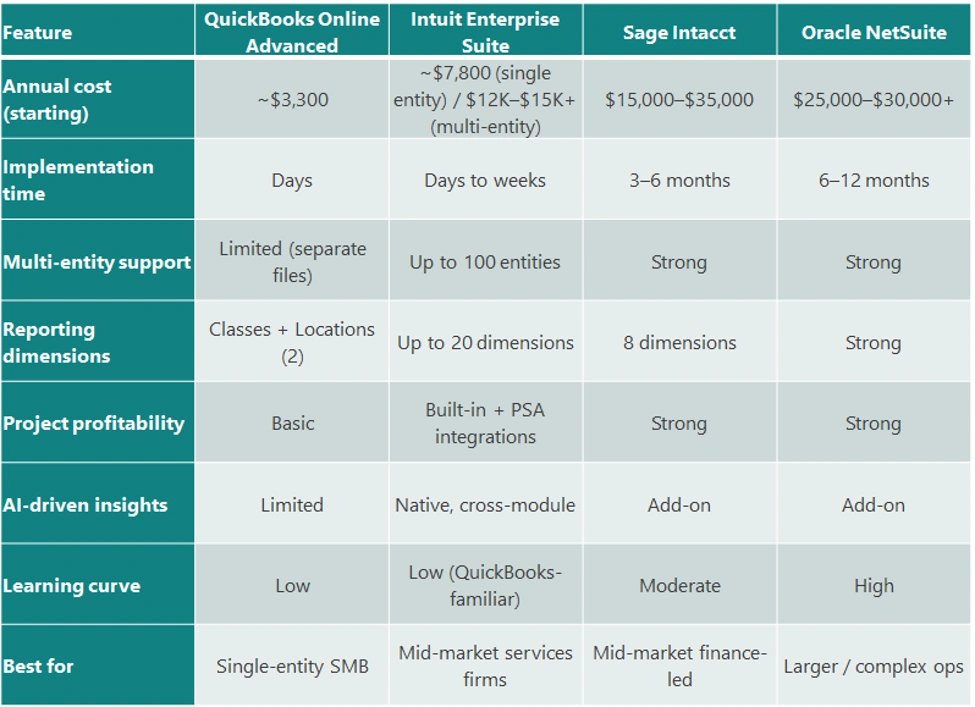
Bottom line: For most professional services firms in the $5M–$100M revenue range, IES delivers 80–90% of what Sage Intacct or NetSuite offer at one-third to one-half the total cost – and with a fraction of the implementation pain.
For deeper side-by-side breakdowns, see our Intuit Enterprise Suite vs NetSuite ERP comparison, IES vs QuickBooks Online Advanced, and IES vs QuickBooks Desktop Enterprise.
Which Professional Services Firms Are the Best Fit?
IES is purpose-built for project-based, service-delivery businesses, including:
- Consultancies (management, strategy, IT, engineering)
- Law firms managing case files, deadlines, and trust accounting
- Architecture and engineering firms tracking project phases and drawings
- Accounting firms serving complex client portfolios
- Marketing and creative agencies billing by project, retainer, or hour
- IT services and managed service providers (MSPs)
- Non-profits running grant- or program-based work
The common thread: project-driven revenue, multi-dimensional reporting needs, and (often) multiple legal entities.
When Intuit Enterprise Suite Is NOT the Right Answer
Honest assessment matters – and as a multi-platform reseller, Fourlane will tell you when IES isn’t the right fit. IES is finance-centric. It may not be the right choice if your firm has:
- Complex supply chains or heavy inventory management
- Manufacturing operations requiring deep MRP or production modules
- Industry-specific operational modules beyond finance (e.g., healthcare EHR, retail POS)
- Highly customized workflow needs beyond what dimensional accounting can handle
In those cases, NetSuite or Acumatica may be the better fit – both of which Fourlane also implements and supports.
IES is also probably overkill for firms still running comfortably on QuickBooks Online Advanced with a single entity, simple reporting, and fewer than 25 employees. The right time to move is when you’re hitting structural limits – multiple entities, dimension-rich reporting, complex project costing, or a finance team spending more time wrangling data than analyzing it.
Not sure which side of the line you’re on? Our Intuit Enterprise Suite Fit Assessment is a fast, no-obligation way to find out.
How to Migrate to Intuit Enterprise Suite: Fourlane’s 5-Step Path
Fourlane has handled thousands of QuickBooks and ERP migrations since 2009. Here’s the framework we use for IES transitions:
- Fit Assessment. Before you spend a dollar, we document your current pain points – entities, dimensions, project reporting needs, integrations, finance team capacity – and confirm IES is actually the right tool.
- Preferred Pricing. As Intuit’s #1 QuickBooks Solution Provider, Fourlane secures Preferred Client Pricing of up to 60% off list and structures the contract around the users and add-ons you actually need.
- Chart of Accounts & Dimension Design. This is where most migrations go wrong. We redesign your reporting structure to use IES’s 20-dimension capability properly, instead of forcing your old class-and-location workarounds into the new platform.
- Data Migration & Integration Setup. Our IES Data Migration team handles clean records, reconciled balances, and integrations with your PSA tool (BigTime, etc.), CRM, and payroll.
- Training, Go-Live & Ongoing Support. Plan for 2–4 weeks of parallel running, then transition into one of our Intuit Enterprise Suite Support Plans for ongoing configuration, troubleshooting, and optimization.
A typical QuickBooks Online to IES migration through Fourlane takes days to a few weeks – not months. Existing bank feeds, integrations, and user configurations are preserved, which is the single biggest reason firms choose IES over a “real” ERP.
Why Work With Fourlane on Your IES Migration?
Plenty of accountants will sell you IES. Far fewer have the technical depth to implement it correctly the first time. Here’s what makes Fourlane different:
- #1 QuickBooks Solution Provider in the country – the highest tier of Intuit partnership, earned by volume and customer outcomes
- 17 years of Intuit ecosystem experience – Fourlane has been doing this since 2009, with thousands of successful migrations across QuickBooks, IES, NetSuite, and Acumatica
- Vendor-neutral expertise – we implement QuickBooks, IES, NetSuite, and Acumatica, so our recommendation isn’t biased toward the one product we happen to sell
- End-to-end services – consulting, implementation, data migration, support, bookkeeping, and fractional CFO services all under one roof
- Preferred Client Pricing – up to 60% off IES list price when you migrate through us
Frequently Asked Questions
Is Intuit Enterprise Suite the same as QuickBooks?
No. IES is built on QuickBooks Online’s infrastructure but is a separate product, sitting above both QuickBooks Online Advanced and QuickBooks Desktop Enterprise. It adds multi-entity management, intercompany workflows, dimensional reporting, and AI automation that the QuickBooks products don’t support natively.
Is Intuit Enterprise Suite better than NetSuite for a consulting firm?
For most mid-market consulting firms ($5M–$100M in revenue) without complex inventory or manufacturing needs, IES delivers comparable financial management capabilities at roughly one-third the total cost – and with implementation measured in days instead of months. NetSuite remains stronger for larger, more operationally complex businesses. See our full IES vs NetSuite comparison for a detailed breakdown.
Can Intuit Enterprise Suite handle multi-entity accounting?
Yes. IES supports up to 100 entities from a single sign-in, with automated intercompany transactions, automatic eliminations, and consolidated reporting across the organization.
Does Intuit Enterprise Suite integrate with project management tools?
Yes. IES integrates with third-party PSA tools like BigTime to pull time, expense, and resource data into financial reporting for accurate project costing and profitability tracking.
How long does it take to migrate from QuickBooks Online to Intuit Enterprise Suite?
For QuickBooks Online users, migration through Fourlane typically takes days to a few weeks. Bank feeds, financial institution connections, third-party app integrations, and user configurations are preserved during the move, and our dedicated migration team handles setup, configuration, and training end-to-end.
Is Intuit Enterprise Suite good for law firms?
Yes. IES is well-suited for law firms because of its project (matter) profitability tracking, multi-dimensional reporting (by partner, practice area, client, office), case file and document management, and multi-entity capabilities. Trust accounting workflows can be configured using dimensions and integrations – Fourlane’s IES Consulting team designs these setups regularly.
How do I know if Intuit Enterprise Suite is the right fit for my firm?
Take Fourlane’s Intuit Enterprise Suite Fit Assessment. It’s a fast, no-obligation evaluation of whether IES is the right platform for your firm – or whether QuickBooks Enterprise, Acumatica, or NetSuite would serve you better.
The Bottom Line
For a professional services firm that has outgrown QuickBooks Online but isn’t ready for a six-figure ERP implementation, Intuit Enterprise Suite is the most natural and lowest-friction upgrade path available. You get real-time project profitability, multi-dimensional reporting, multi-entity consolidation, and AI-driven insights without the six-month implementation, the seven-figure price tag, or retraining your entire finance organization.
The question for most growing services firms isn’t whether to make this move. It’s whether you make it now, while it’s an upgrade decision, or later, when the cracks in your current stack have become an operational liability.
Ready to evaluate Intuit Enterprise Suite for your firm? Talk to a Fourlane expert to find out if you qualify for ProAdvisor Preferred Client Pricing and to scope a migration timeline.
Ready to Evaluate Intuit Enterprise Suite for Your Professional Services Firm?
If your firm has outgrown QuickBooks Online and needs better project profitability reporting, multi-entity visibility, and AI-powered financial insights, Intuit Enterprise Suite may be the ideal next step.
Contact Fourlane to schedule a personalized Intuit Enterprise Suite demo, discuss pricing options, and determine whether IES is the right fit for your firm’s growth goals.
- Evaluate Intuit Enterprise Suite with a professional services ERP expert
- Compare IES against NetSuite, Sage Intacct, and QuickBooks Online Advanced
- Review project profitability, multi-entity, and dimensional reporting requirements
- Discuss implementation timelines, integrations, migration, and pricing