

Staff Accountant vs. Senior Accountant: Roles, Responsibilities, and When to Hire Each
Walk into any growing business and ask, “Who is your accountant?” and you may get a confusing answer. One company’s staff accountant may be doing the same work another company gives to a senior accountant, while a third company may call both roles “the accountant.”
Accounting job titles are not always consistent, which makes it difficult to know what you are paying for or what your business actually needs to hire.
This guide breaks down two core in-house accounting roles, staff accountant and senior accountant, including what each role does, where each fits in the accounting team structure, what each typically costs, and when your business may need one.
The simplest way to think about it is this: staff accountants record and report. Senior accountants own the close and guide junior staff. Both roles become important as a business outgrows basic bookkeeping, but they solve different problems.
- Quick Comparison: Staff Accountant vs. Senior Accountant
- What Is a Staff Accountant?
- What Is a Senior Accountant?
- Senior Accountant vs. Staff Accountant
- How the Accounting Hierarchy Works
- Frequently Asked Questions
Quick Comparison: Staff Accountant vs. Senior Accountant
A staff accountant usually handles recurring accounting tasks, reconciliations, and basic financial reporting. A senior accountant handles more complex accounting work, owns the month-end close, and may review the work of junior team members.
| Dimension | Staff Accountant | Senior Accountant |
|---|---|---|
| Primary focus | Recording transactions, reconciliations, and basic reporting | Complex accounting work, month-end close, and financial statement preparation |
| Time horizon | Backward-looking | Backward-looking, with more ownership and judgment |
| Reports to | Controller, accounting manager, or owner | Controller or accounting manager |
| Manages | Usually no one, though they may support interns or AP/AR clerks | Often staff accountants, bookkeepers, or AP/AR clerks |
| Typical credentials | Bachelor’s degree in accounting, with CPA in progress optional | Bachelor’s degree in accounting, CPA common, and 3 to 7 years of experience |
| Typical salary, U.S. | About $54K to $75K | About $75K to $110K |
| Hire when | Your transaction volume has grown beyond bookkeeping alone | You need a senior contributor to own the close and lead junior staff |
What Is a Staff Accountant?
A staff accountant is the day-to-day workhorse of the accounting function. This role handles the core transactional and reporting work that keeps a company’s books accurate, current, and ready for review.
Staff Accountant Responsibilities
Staff accountants typically support recurring accounting operations and month-end close preparation. Common responsibilities include:
- Recording financial transactions in the general ledger
- Completing bank and credit card reconciliations to confirm cash accuracy
- Processing accounts payable and accounts receivable, including bills, payments, and collections support
- Preparing journal entries and month-end close support items, such as accruals, prepaids, and depreciation
- Preparing basic financial statements, including the profit and loss statement, balance sheet, and cash flow statement, for review
- Supporting tax preparation by gathering documents and reconciling accounts
- Helping with audit support by pulling documentation and answering basic auditor questions
- Maintaining the chart of accounts under controller or accounting manager direction
A staff accountant is primarily backward-looking. Their job is to capture what happened accurately and on time. They usually do not design financial strategy, build budgets, or interpret what the numbers mean for the business.
Staff Accountant Credentials and Background
A staff accountant typically holds a bachelor’s degree in accounting, finance, or a related field. CPA certification is common but not universal at this level. Many staff accountants pursue the CPA exam during their first few years on the job.
Staff Accountant Salary Range
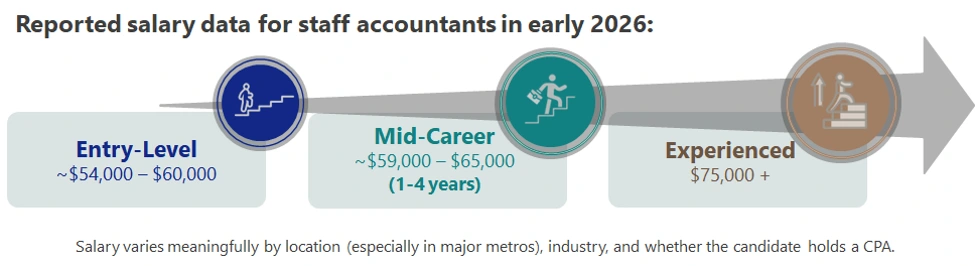
Staff accountant salaries often fall around $54K to $75K in the United States, depending on location, industry, company size, software experience, and accounting complexity.
When to Hire a Staff Accountant
You may need a staff accountant when your business has outgrown part-time bookkeeping but does not yet need a full accounting department.
- Your transaction volume exceeds what a part-time bookkeeper can handle accurately.
- Your monthly close is taking too long or producing errors.
- You need in-house support for audits, tax preparation, or external reporting.
- You have multi-entity, inventory, or revenue recognition complexity that requires accounting judgment, not just data entry.
A common growth pattern is that the bookkeeper handling everything eventually becomes the bottleneck. Adding a staff accountant, while allowing the bookkeeper to focus more on AP and AR, is often the natural next step.
What Is a Senior Accountant?
A senior accountant sits between the staff accountant and the controller. This role handles more complex accounting work, owns the month-end close, and often serves as the most senior individual contributor on the accounting team.
In many growing businesses, the senior accountant also has light supervisory responsibility over staff accountants, bookkeepers, or AP/AR clerks.
Senior Accountant Responsibilities
Senior accountants typically handle the accounting work that requires judgment, ownership, and technical depth. Common responsibilities include:
- Owning the month-end, quarter-end, and year-end close process
- Preparing accruals, prepaids, depreciation, intercompany entries, and consolidations
- Preparing financial statements for controller review
- Completing complex reconciliations, including multi-entity, multi-currency, intercompany, and balance sheet account analyses
- Managing revenue recognition and deferred revenue schedules under ASC 606 or applicable standards
- Supporting inventory accounting and cost analysis, including standard costs, variances, and physical count reconciliations
- Reviewing journal entries, reconciliations, and AP/AR coding prepared by junior staff
- Leading audit preparation by pulling schedules, drafting workpapers, and answering auditor questions
- Preparing tax schedules in coordination with internal tax staff or external CPA firms
- Identifying close inefficiencies and suggesting process or policy improvements
- Mentoring junior staff on accounting policies, ERP systems, and close procedures
A senior accountant is still primarily backward-looking, but the role requires more judgment and ownership than a staff accountant role. This is the person the owner, controller, or CFO relies on to run the close, not just contribute to it.
Senior Accountant Credentials and Background
Senior accountants usually hold a bachelor’s degree in accounting and have 3 to 7 years of progressive accounting experience. A CPA is common at this level, although not always required.
Industry experience also matters. A senior accountant moving from public accounting into industry, or from one company to another with similar accounting complexity, is a common path.
Senior Accountant Salary Range
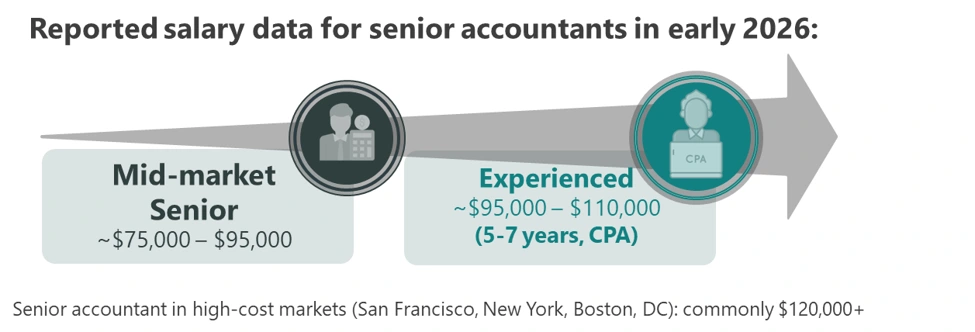
Senior accountant salaries often fall around $75K to $110K in the United States. Experienced CPAs, candidates in major metro areas, and accountants with technical industry experience may command higher compensation.
When to Hire a Senior Accountant
You may need a senior accountant when the close requires more ownership, technical judgment, and review than your current accounting structure can provide.
- Your staff accountant is producing accurate transactional work, but the close is still slow or messy.
- You have technical accounting complexity, such as revenue recognition, multi-entity accounting, multi-currency, inventory, or project accounting.
- You are not yet ready for a controller, but the owner or external CPA can no longer provide close-level oversight every month.
- You want a clear succession path toward an internal controller hire.
- You want to free up the controller or fractional controller from hands-on close work so they can focus on supervision, reporting, and process improvement.
In many growing businesses, the senior accountant is the first hire who brings true accounting judgment rather than just accounting throughput. That is often the point where the monthly close starts to become more consistent and less reactive.
Senior Accountant vs. Staff Accountant
The clearest difference between a senior accountant and a staff accountant is ownership. A staff accountant performs assigned accounting tasks. A senior accountant owns workstreams.
For example, a staff accountant may complete a reconciliation, prepare a journal entry, or process AP invoices. A senior accountant may own the full month-end close, manage the revenue schedule, review the inventory module, and make judgment calls on accruals, classifications, and accounting treatment without needing step-by-step direction.
Senior accountants also typically have technical depth that staff accountants do not yet have. That may include revenue recognition, lease accounting, multi-entity consolidation, construction percentage-of-completion accounting, SaaS deferred revenue, or manufacturing inventory accounting.
| Question | Better Fit |
|---|---|
| Do you need someone to handle reconciliations, AP/AR support, journal entries, and basic reporting? | Staff accountant |
| Do you need someone to own the month-end close and review junior work? | Senior accountant |
| Do you have multi-entity, inventory, revenue recognition, or project accounting complexity? | Senior accountant |
| Are you just starting to move beyond bookkeeping? | Staff accountant |
How the Accounting Hierarchy Works in Practice
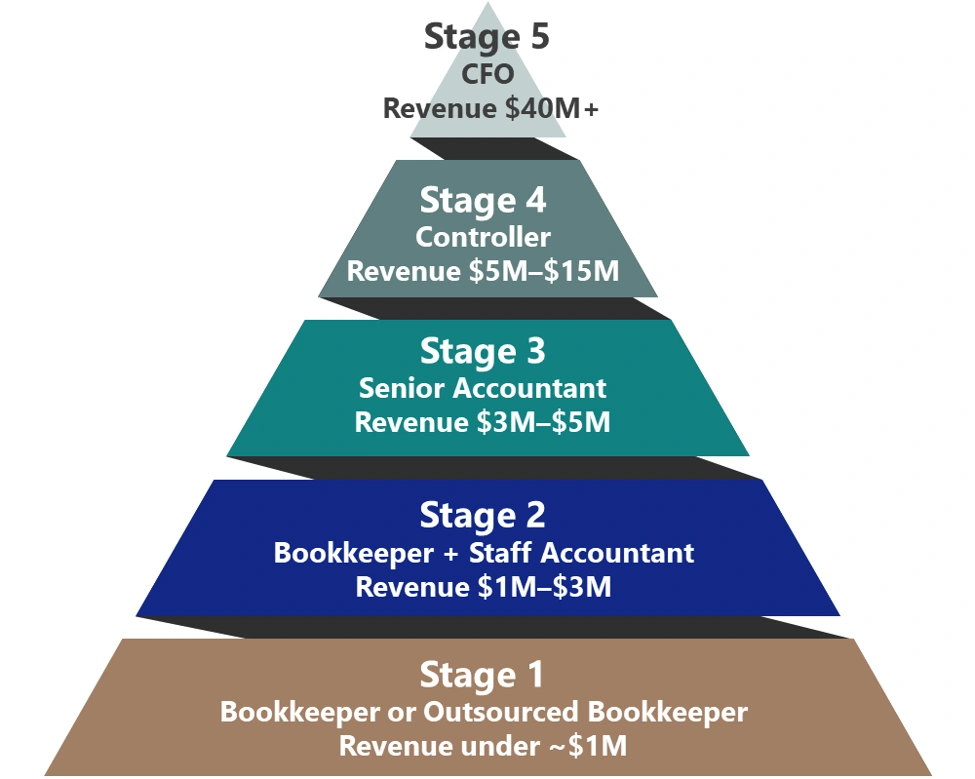
Most growing businesses build their accounting team in stages as revenue, transaction volume, reporting needs, and operational complexity increase.
Stage 1: Bookkeeper or Outsourced Bookkeeping
At the earliest stage, often under about $1M in revenue, a bookkeeper records transactions and reconciles accounts. The owner usually reviews the numbers and handles strategic decisions personally.
Stage 2: Bookkeeper Plus Staff Accountant
As the business grows, often around $1M to $3M in revenue, transaction volume and accounting complexity may exceed bookkeeping alone. A staff accountant can take over more sophisticated work, including journal entries, month-end close support, and financial statement preparation. The owner, outsourced controller, or fractional CFO may still provide oversight.
Stage 3: Add a Senior Accountant
As the company reaches higher complexity, often around $3M to $5M in revenue, the close may require accounting judgment rather than just throughput. A senior accountant can take ownership of month-end close, complex reconciliations, financial statement preparation, and review of junior work.
Beyond this stage, businesses often add controller capacity and then CFO-level capacity. Fourlane’s CFO Advisory Services can help growing companies evaluate financial reporting needs, team structure, and systems alignment.
Not Sure What Finance Role Your Company Needs?
Hiring the wrong accounting role can create more confusion, not less. The right next hire depends on your revenue stage, current team, systems, and financial pain points.
Take Fourlane’s 3-minute Finance Hire Diagnostic to get a personalized recommendation based on 10 questions about your company’s current finance function.
- Identify whether you need bookkeeping, staff accounting, controller, or CFO-level support
- Understand the role your business may be missing
- Get practical next steps for your current stage
Frequently Asked Questions
What is the main difference between a staff accountant and a senior accountant?
A staff accountant performs assigned accounting tasks, such as reconciliations, journal entries, AP/AR processing, and basic financial statement preparation. A senior accountant owns larger workstreams, such as the month-end close, revenue schedules, inventory accounting, and review of junior staff work.
Do small businesses need both a staff accountant and a senior accountant?
Not always. Most small businesses progress in stages: bookkeeper, then staff accountant, then senior accountant, and then controller. A $2M-revenue business may only need a staff accountant with outsourced controller oversight, while a company in the $5M to $10M range may benefit from both roles.
What is the typical salary jump from staff accountant to senior accountant?
The jump is often around 35% to 50%. Staff accountants typically earn about $54K to $75K, while senior accountants often earn about $75K to $110K. Compensation varies by market, industry, credentials, and technical accounting requirements.
Can a senior accountant replace a controller?
Sometimes, especially in a smaller business with external controller or CFO oversight. However, once the business has multiple accounting staff, complex internal controls, audit obligations, or more formal reporting requirements, the controller role usually becomes a distinct hire.
Do I need a CPA to hire a senior accountant?
It depends on the complexity of your accounting. A CPA is not always required, but it can be valuable if your business has GAAP-compliant financials, audits, complex revenue recognition, multi-entity consolidation, or technical accounting requirements.
Conclusion: Match the Hire to the Stage
Staff accountants and senior accountants are not interchangeable. Staff accountants record what happened. Senior accountants own the close and help make sure it is accurate, timely, and ready for review.
A growing business may need both functions over time, but it rarely needs both full-time at the same stage. The right hire depends on transaction volume, accounting complexity, reporting expectations, and the amount of oversight available from a controller, outsourced controller, or CFO.
For companies evaluating whether to hire in-house or use outsourced support, Fourlane offers bookkeeping services and accounting systems expertise to help your finance team operate with better structure, cleaner data, and stronger reporting visibility.
Need Help Building the Right Accounting Team Structure?
The right accounting role depends on your company’s transaction volume, reporting needs, systems, and growth stage.
Contact Fourlane to speak with a QuickBooks, ERP, or accounting systems expert about the finance team structure and support model that fits your business.
- Bookkeeping and accounting support
- Month-end close and reporting process improvement
- Controller and CFO advisory support
- QuickBooks and ERP system guidance