

If your finance team is still stitching together month-end reports from multiple spreadsheets and disconnected systems, you are not alone. AI financial reporting in Intuit Enterprise Suite is changing how growing companies close their books, consolidate multiple entities, and gain real-time visibility into financial performance.
In a recent webinar, we walked through how AI agents are reshaping financial reporting inside Intuit Enterprise Suite (IES), Intuit ERP for growing and complex businesses. Instead of manually assembling numbers after the fact, finance teams can spend more time analyzing current information and deciding what to do next.
Explore AI Financial Reporting in Intuit Enterprise Suite
- Why growth creates financial reporting complexity
- How AI financial reporting changes the close
- Real-time multi-entity financial visibility
- AI agents for finance teams
- Results of financial reporting automation
- Three outcomes for finance teams
- Frequently asked questions
Why Growth Outpaces Traditional Finance Tools
As a business grows, it rarely grows in a straight line. New entities, locations, and product lines often bring another system, spreadsheet, or method of tracking financial information.
The result is a fragmented technology stack. Instead of working from one connected source of financial information, teams may have to move data manually between applications before they can understand company-wide performance.
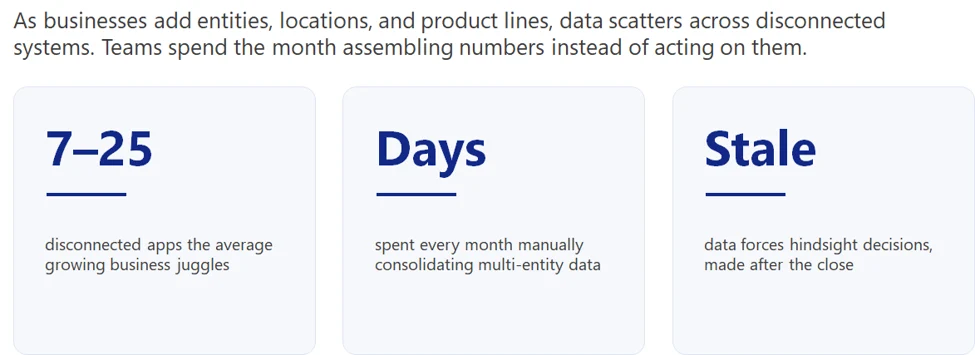
That fragmentation has a real cost. At month-end, someone on the finance team, often one of its most capable people, can spend days pulling data from separate systems, reconciling it, and assembling reports leadership can use.
By the time those reports are complete, the information may already be outdated. Leadership is forced to make decisions by looking backward rather than seeing what is happening across the business now.
This is not simply a people problem. It is a systems problem. Many accounting and financial reporting environments were never designed to manage the complexity that comes with rapid growth.
The Shift From Assembling Numbers to AI Financial Reporting
Traditional financial reporting requires teams to export and rekey data, manually match transactions, and rebuild many of the same reports every accounting period. After all that work, the primary question the team can answer is what happened, often well after it happened.
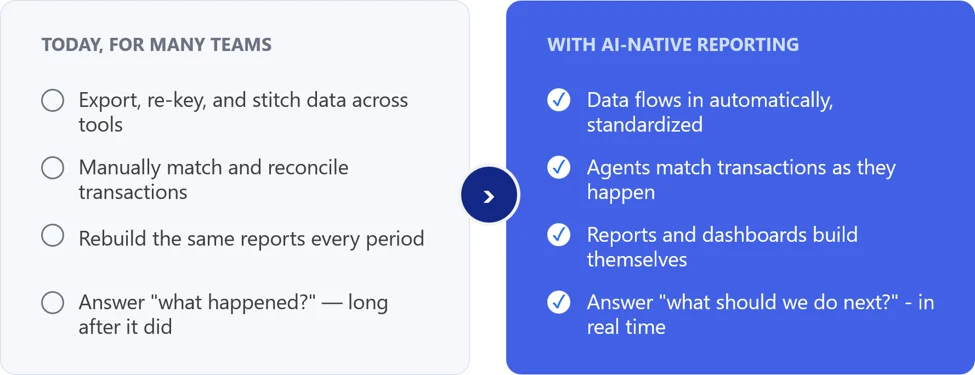
With AI built into the platform, data can flow into Intuit Enterprise Suite in a more standardized way. AI agents can assist with transaction matching, while reports, dashboards, and financial insights stay more current.
That changes the finance team’s focus. Instead of spending most of its time assembling historical numbers, the team can spend more time answering a more valuable question: What should we do next?
Real-Time Financial Visibility Across Multiple Entities
Real-time financial visibility is the foundation for faster reporting and better decisions. Intuit Enterprise Suite is designed as an AI-native ERP, meaning intelligence and automation are integrated into the platform rather than added as separate tools after implementation.
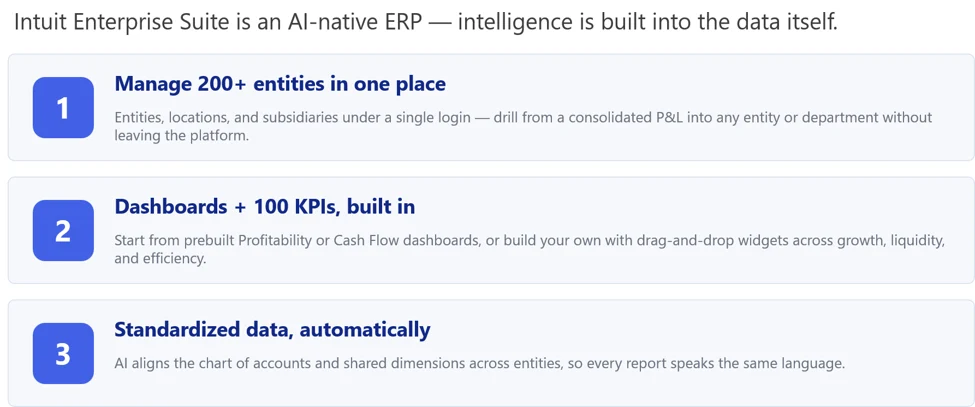
Three capabilities support a real-time, cross-entity financial view:
- Scale of management: Finance teams can manage 200+ entities under a single login and drill from a consolidated profit and loss statement into individual entities or departments without leaving the platform.
- Reporting that is ready to use: Prebuilt dashboards provide visibility into profitability, cash flow, growth, liquidity, efficiency, and other KPIs. Teams can also create customized dashboard views when standard reporting does not meet their needs.
- A standardized chart of accounts: AI helps standardize the chart of accounts and shared dimensions across entities so financial information follows a consistent structure. That consistency supports faster consolidated reporting.
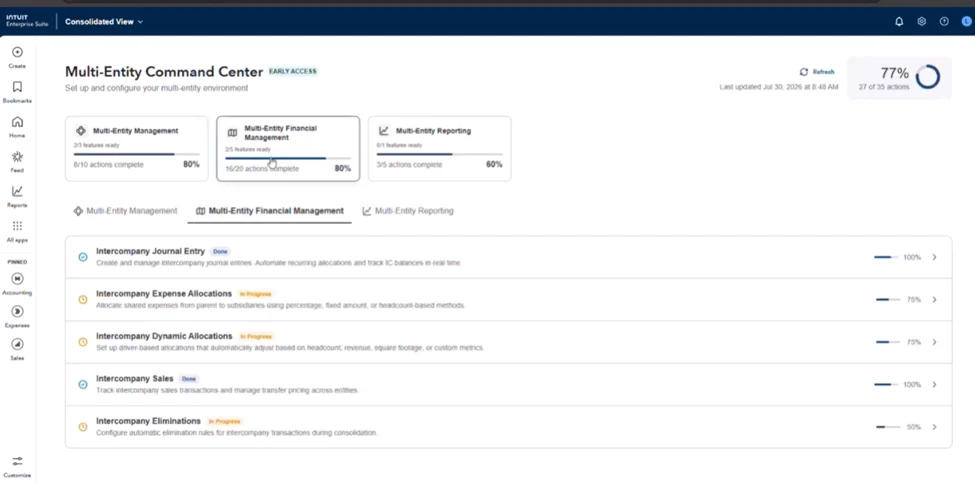
For organizations struggling with separate company files, inconsistent reporting structures, or spreadsheet-based consolidation, the underlying configuration matters as much as the software. Fourlane’s Intuit Enterprise Suite consulting services help businesses design multi-entity structures, reporting, KPIs, processes, and financial workflows around their operational needs.
Meet the AI Agents for Finance Teams
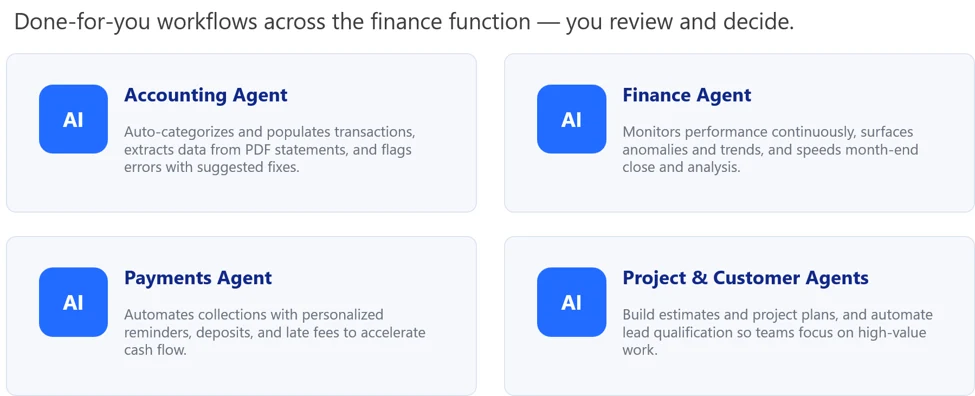
The centerpiece of the webinar was a closer look at AI agents. They can be thought of as a virtual team that assists with repetitive, time-consuming financial work while keeping people in control of decisions that require judgment.
The model is straightforward: your team directs, and the agents execute the repetitive work. Finance professionals remain responsible for reviewing exceptions, applying judgment, and making final decisions.
Four AI agents took the spotlight:
Accounting Agent and Automated Transaction Matching
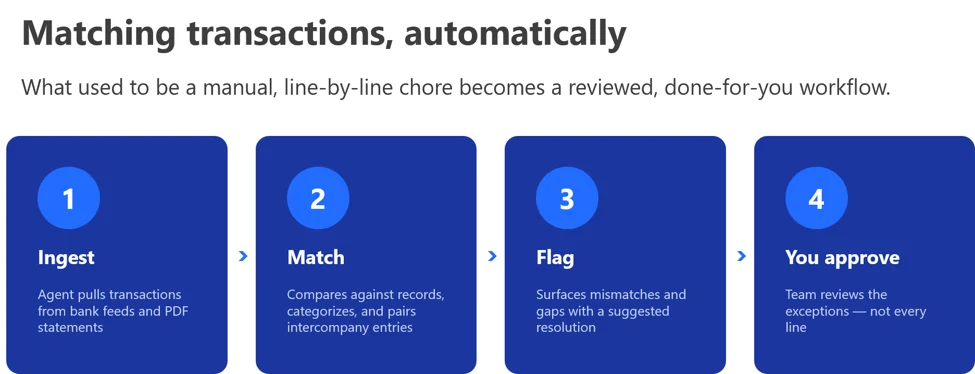
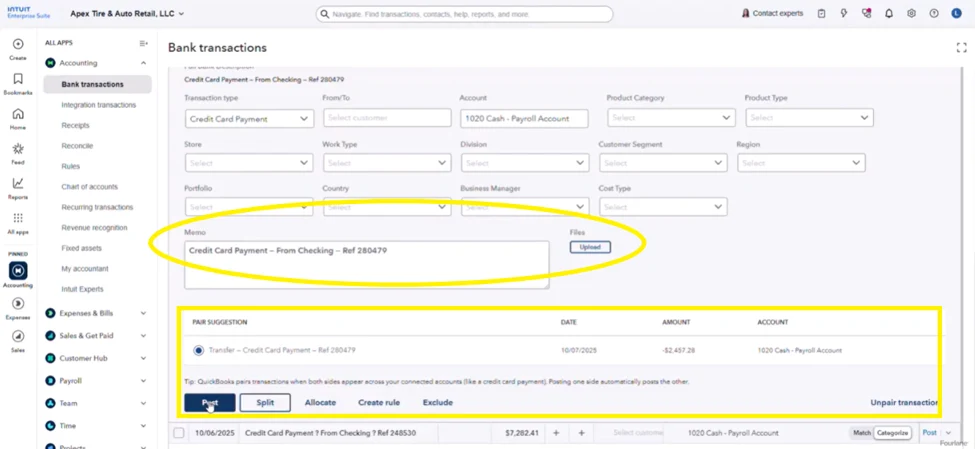
The Accounting Agent handles automated transaction matching, one of the most repetitive parts of the close process. Its workflow can be broken into four steps:
- Ingest: Transactions are pulled from sources such as bank feeds and PDF statements.
- Match: The agent compares transactions against existing records and pairs applicable intercompany entries.
- Flag: Items that do not reconcile cleanly are surfaced for review, along with a suggested resolution.
- Approve: Your finance team reviews the exceptions that require human judgment rather than manually reviewing every transaction.
Instead of processing hundreds of transactions individually, finance professionals can focus their attention on the smaller number of transactions that genuinely need investigation or approval.
Finance Agent for Continuous Financial Analysis
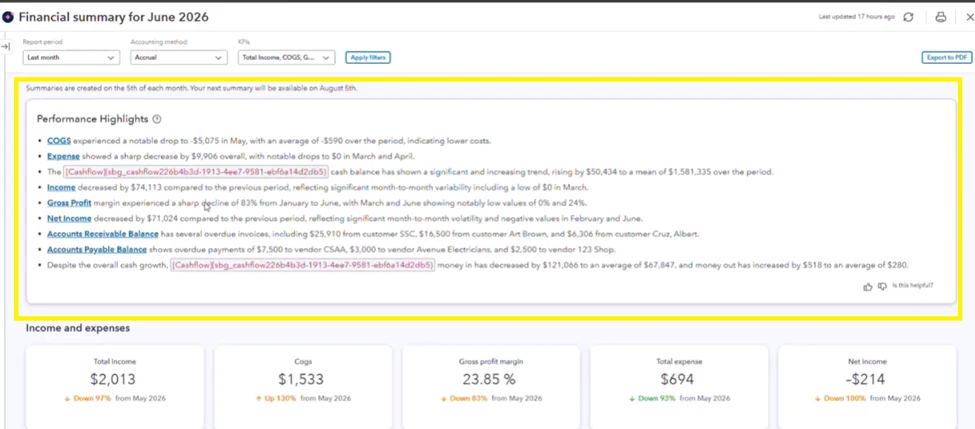
The Finance Agent functions more like an analyst. It continuously monitors financial performance and surfaces anomalies and trends before they become unexpected month-end surprises.
It can also produce a monthly financial summary that identifies factors such as major outstanding customer balances, vendor activity, and movements in gross margin and net income. This gives finance leaders a faster starting point for management reporting and deeper analysis.
Payments Agent for Accounts Receivable and Cash Flow
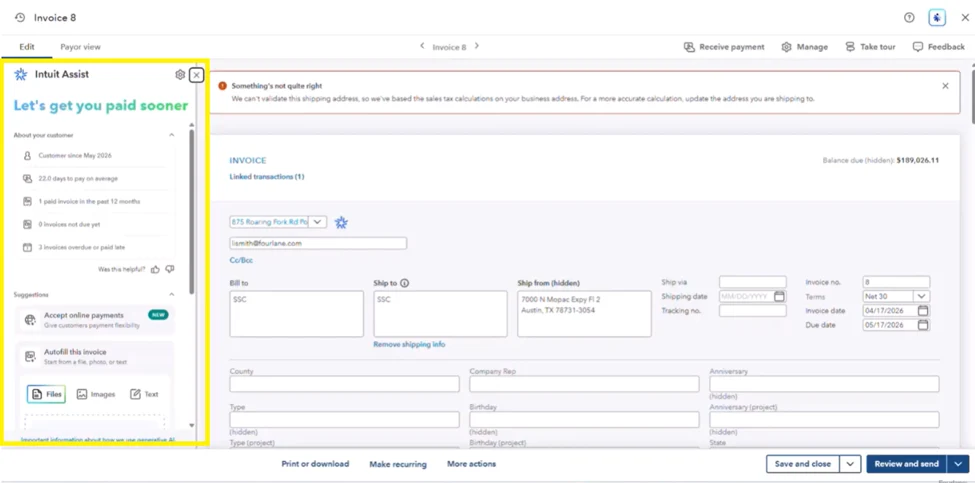
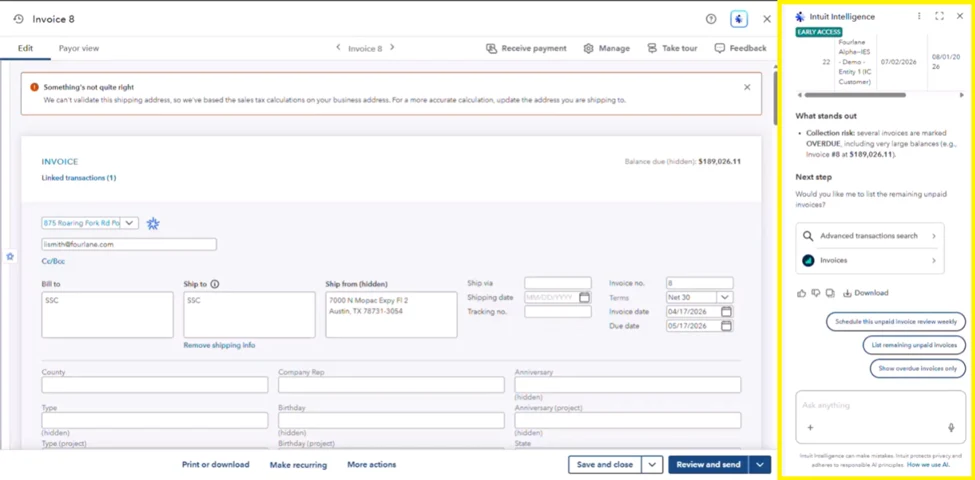
The Payments Agent focuses on cash flow at both the individual invoice level and across the organization’s broader accounts receivable activity.
For a specific invoice, it can surface information about the customer and payment behavior. Across receivables, it can aggregate outstanding balances, identify risk, and draft personalized payment reminders for the team to review before sending.
Project Management Agent for Estimates and Project Workflows
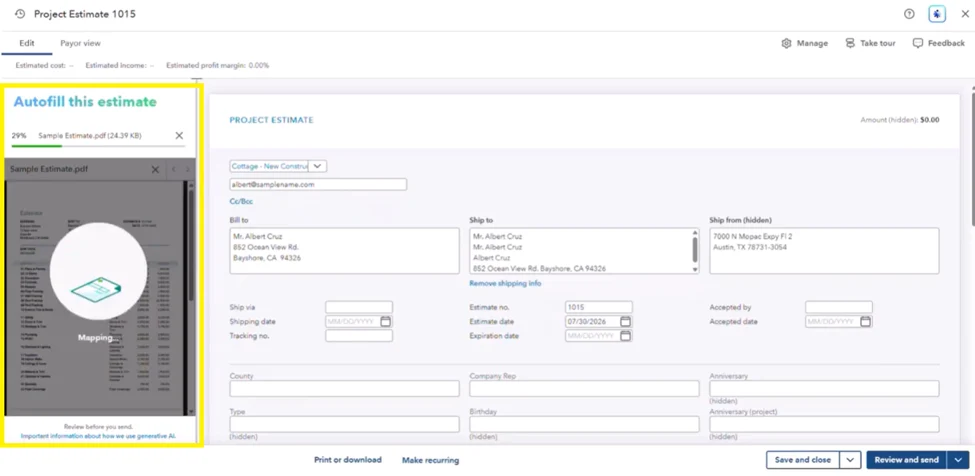
The Project Management Agent can work with unstructured documents such as competitor quotes, scanned bids, and emailed proposals. It extracts relevant scope information and uses that information to help populate an estimate using the company’s own pricing rather than copying pricing from the source document.
A process that previously required someone to manually reconstruct an estimate can become a review-focused workflow, helping project-based businesses reduce repetitive data entry while keeping people responsible for final approval.
What Financial Reporting Automation Adds Up To
The biggest outcomes are straightforward: faster closes and sharper decisions. The results shared during the webinar came directly from Fourlane client engagements rather than projections.
- A seven-entity field services group that previously spent weeks on manual consolidation now closes in about 10 business days.
- A chart-of-accounts redesign reduced general ledger complexity by more than half for one client, simplifying reporting and reducing opportunities for errors across entities.
- A multi-entity organization replaced its spreadsheet consolidation process with one-click consolidated profit and loss and balance sheet reporting.
- A construction group operating five entities in separate files moved into one unified, single-login environment.
One finance leader described work that previously took a full day, and sometimes two, being completed in minutes. The time recovered from manual reporting can then shift toward analysis, planning, and strategic decision support.
Migration also does not necessarily require a year-long ERP project. According to the Fourlane client data presented during the webinar, 90% of customers complete their migration in under 30 days.
Businesses evaluating a move can work with Fourlane on an Intuit Enterprise Suite Fit Assessment before committing to implementation. For organizations moving from QuickBooks, Sage, another ERP, or multiple accounting systems, Fourlane also provides Intuit Enterprise Suite data migration services.
Three Outcomes for Your Finance Team
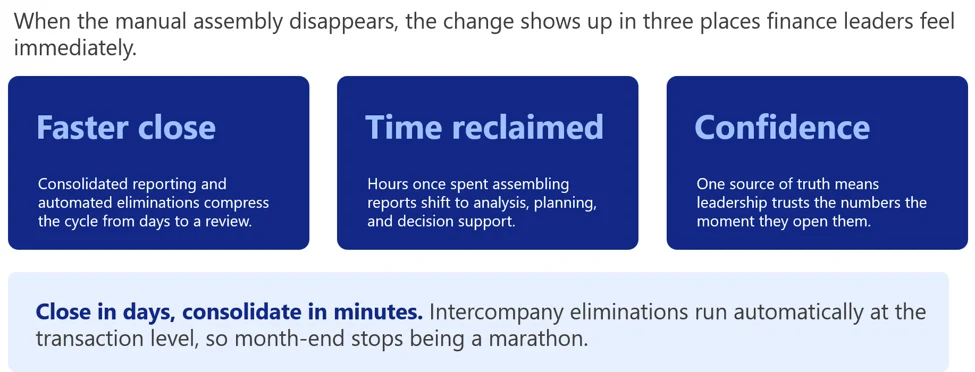
When manual financial assembly is reduced, the impact shows up in three areas that finance leaders can feel immediately.
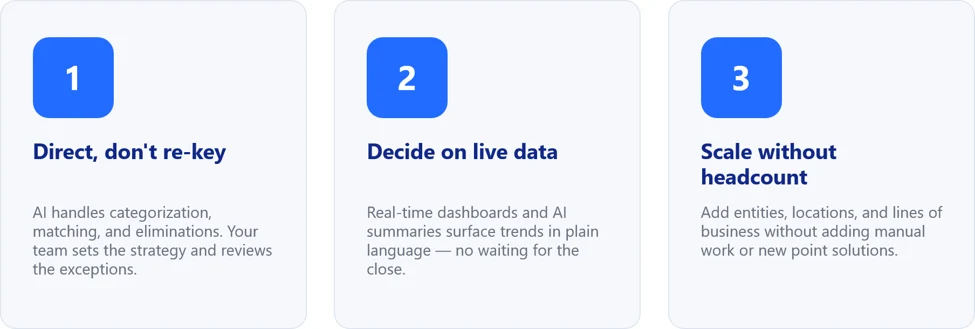
- Your team directs instead of rekeys. AI assists with categorization, transaction matching, and eliminations, allowing finance professionals to focus on strategy, judgment, and exception review.
- You make decisions using live data. Real-time dashboards and plain-language AI summaries make current financial information available without waiting weeks for another spreadsheet-based close process.
- You can scale without automatically adding manual work. Adding entities, locations, and product lines does not have to mean adding another spreadsheet process or disconnected point solution.
Smarter financial reporting is valuable when it turns directly into faster, more confident decisions.
See AI Financial Reporting on Your Own Numbers
The best way to determine whether AI-powered reporting can improve your finance operation is to evaluate it against your own entities, intercompany activity, reporting requirements, and close process.
Fourlane’s IES Fit Assessment helps leadership teams evaluate whether Intuit Enterprise Suite is the right ERP for their business, identify readiness gaps, review financial and operational requirements, and establish a practical path forward.
Frequently Asked Questions About AI Financial Reporting
What is AI financial reporting in Intuit Enterprise Suite?
AI financial reporting in Intuit Enterprise Suite uses built-in AI agents and automation to assist with tasks such as transaction matching, consolidated reporting, and financial summaries. The goal is to give finance teams more current, standardized reporting across entities without manually assembling the same information every accounting period.
How do AI agents help with multi-entity consolidation?
AI agents can support standardized charts of accounts and shared dimensions across entities, help match intercompany transactions, and reduce the manual work involved in producing consolidated profit and loss and balance sheet reports.
Will AI agents replace my finance team?
No. The AI agents described in Intuit Enterprise Suite are designed to handle repetitive and mechanical work such as categorization and matching. Finance professionals retain control over exceptions, approvals, judgment, analysis, and strategy.
How long does it take to migrate to Intuit Enterprise Suite?
According to Fourlane client data presented in the webinar, 90% of customers complete their migration in under 30 days. Actual migration timelines can depend on factors such as data quality, the number of entities, integrations, reporting requirements, and the complexity of the existing accounting environment.
Ready to Improve Financial Reporting With Intuit Enterprise Suite?
If disconnected systems, manual consolidation, and slow month-end reporting are limiting your finance team, Fourlane can help you determine whether Intuit Enterprise Suite is the right next step.
Request an Intuit Enterprise Suite Fit Assessment to speak with an ERP and accounting systems expert about your reporting requirements, multi-entity structure, close process, and growth plans.
- Evaluate your current financial systems and reporting workflows
- Review multi-entity, consolidation, and dimensional reporting requirements
- Identify data migration and implementation considerations
- Build a practical roadmap for Intuit Enterprise Suite